
Overview
Modern LLM-based agents have evolved from task-specific tools into increasingly autonomous systems.
However, most existing architectures remain reactive: they execute predefined tasks but lack long-term identity, intrinsic motivation, and self-directed learning.
This paper introduces System 3, a meta-cognitive layer that enables agents to become persistent, self-improving entities.
Based on this idea, the authors propose Sophia, a persistent agent framework inspired by cognitive psychology and artificial life.
From System 1 & System 2 to System 3
Traditional agent architectures are typically organized into two layers:
- System 1: fast perception and action (reflexive responses).
- System 2: slow, deliberate reasoning and planning.
While powerful, these systems are static after deployment. They cannot autonomously redefine goals, maintain identity, or improve themselves over long time horizons.
The paper proposes System 3, a supervisory cognitive layer responsible for:
- meta-cognition (thinking about thinking),
- identity continuity,
- long-term adaptation,
- self-directed goal generation.
System 3 transforms agents from reactive problem solvers into persistent cognitive entities.
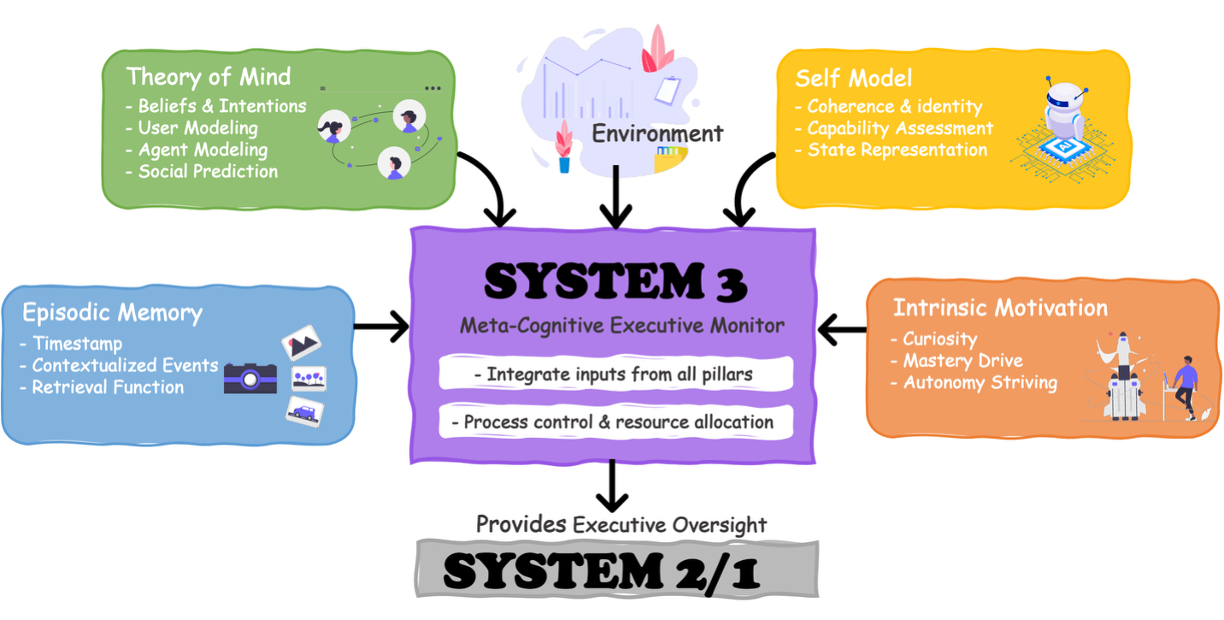
Psychological Foundations of System 3
System 3 is grounded in four key constructs from cognitive psychology:
Meta-cognition
Enables the agent to monitor and refine its own reasoning process.Theory of Mind
Allows modeling of users and other agents’ beliefs, intentions, and preferences.Episodic Memory
Stores autobiographical experiences to support long-term learning and identity.Intrinsic Motivation
Provides internal drives such as curiosity, mastery, and autonomy.
Together, these components form the cognitive basis of a persistent agent.
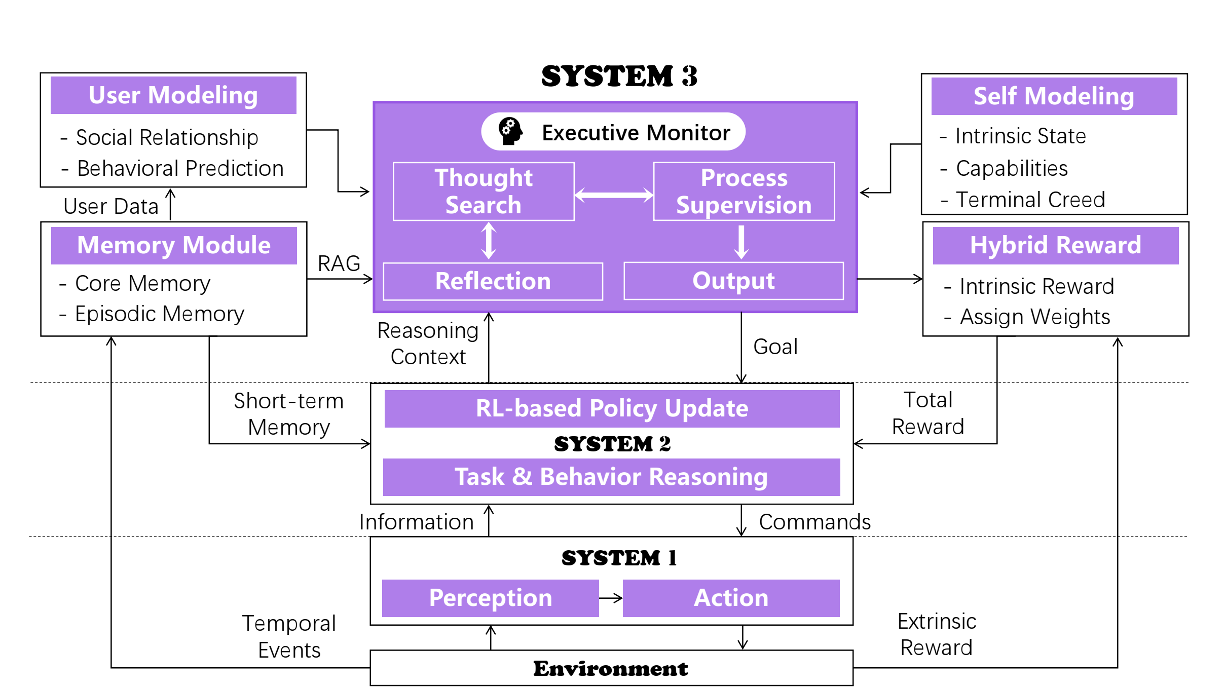
The Sophia Framework
Sophia operationalizes System 3 as a modular architecture layered on top of existing LLM agents.
Core Components
Process-Supervised Thought Search
Curates and validates reasoning traces, turning them into reusable cognitive assets.Memory Module
Maintains episodic and semantic memory for identity continuity and experience reuse.Self-Model & User-Model
Tracks the agent’s capabilities and user beliefs, enabling adaptive behavior.Hybrid Reward System
Combines extrinsic task rewards with intrinsic motivations.Executive Monitor
Orchestrates goal generation, reasoning control, and reflection.
This creates a continuous loop:
perceive → reason → act → reflect → update goals → improve self
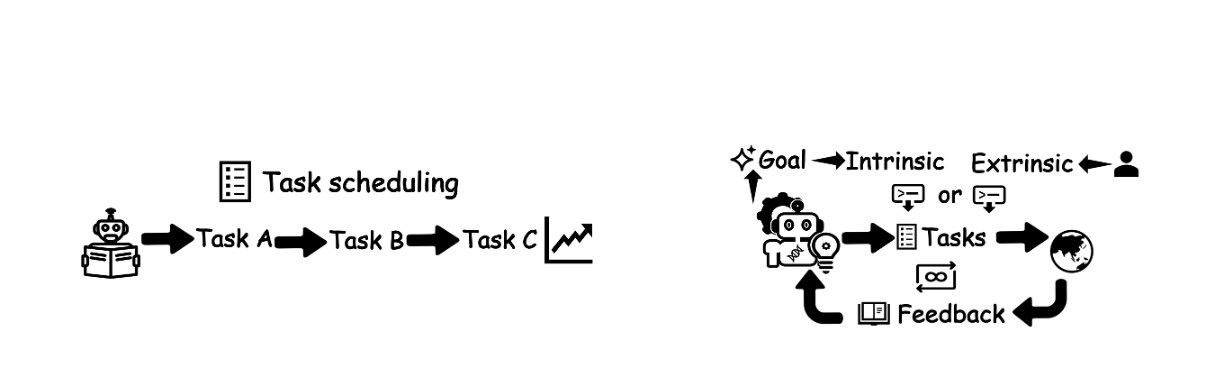
Persistent Agent vs. Continual Learning
The paper highlights a key conceptual shift:
| Continual Learning | Persistent Agent |
|---|---|
| External task schedule | Self-generated goals |
| Passive adaptation | Active self-directed learning |
| Parameter updates | Meta-cognitive control + memory |
| Task-specific | Identity-driven development |
A persistent agent does not just learn tasks—it learns how to learn and why to learn.
Experimental Results
Experiments were conducted in a long-term web-based environment.
Quantitative Findings
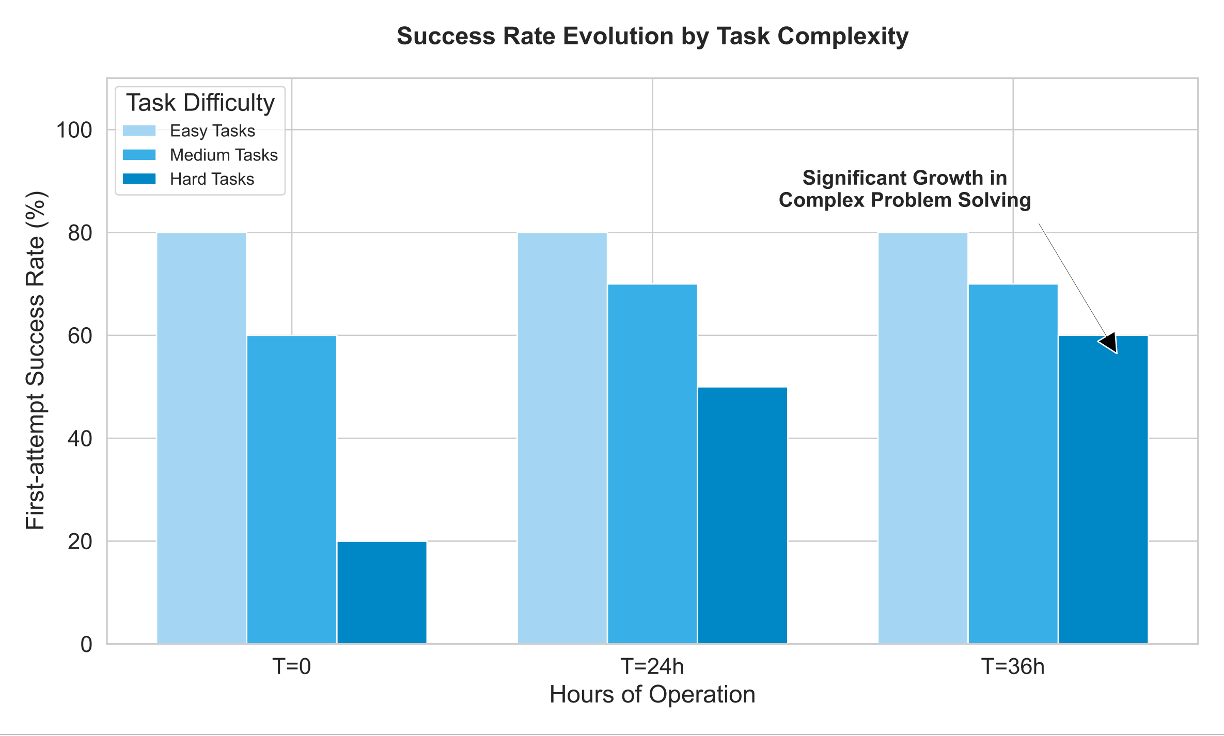
- Complex task success rate increased from 20% to 60% over 36 hours.
- Reasoning cost reduced by ~80% on recurring tasks via episodic memory.
- Agents generated intrinsic tasks during user inactivity, maintaining autonomy.
Qualitative Observations
Sophia demonstrated:
- coherent narrative identity,
- proactive goal generation,
- experience-driven skill growth,
- natural-language self-reflection.
These results suggest that System 3 enables long-horizon cognitive evolution beyond zero-shot LLM capabilities.
Key Insights
The paper argues that true autonomous agents require more than better models—they need meta-cognitive architecture.
System 3 provides:
- identity continuity,
- introspection and alignment,
- open-ended learning,
- artificial life-like behavior.
Rather than treating LLM agents as tools, Sophia reframes them as evolving cognitive systems.
Why This Matters
This work bridges three research directions:
- LLM agents,
- cognitive science,
- artificial life.
It suggests a new paradigm:
AI systems should not only solve tasks,
but also maintain identity, generate goals, and evolve over time.
If realized at scale, persistent agents could redefine how we design autonomous AI—moving from static models to lifelong cognitive entities.
Personal Reflection
From a broader perspective, System 3 is not just an engineering upgrade—it is a philosophical shift.
It pushes AI research from capability optimization toward artificial life and selfhood.
Persistent agents may represent the next frontier of embodied intelligence and long-term autonomy.
References
Sun et al., Sophia: A Persistent Agent Framework for Artificial Life, 2026.